

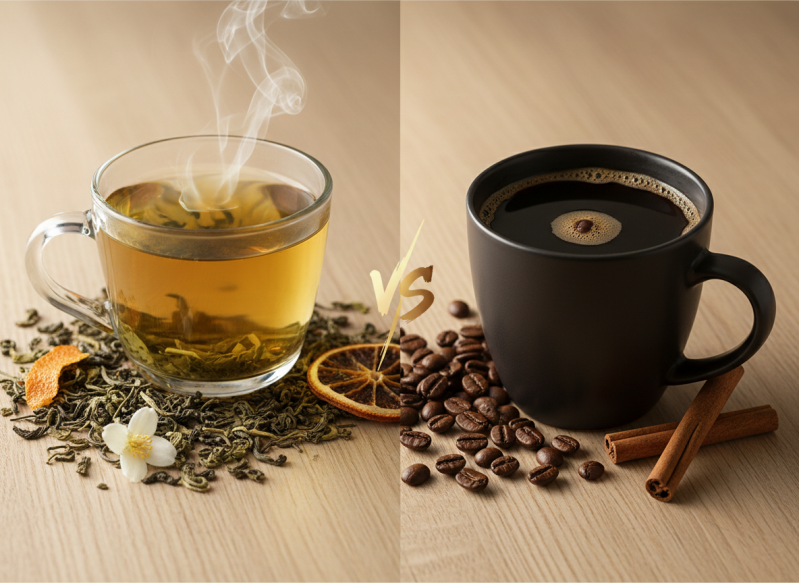
Tea vs. Coffee: Why Your Next Cup Might Just Be a Leaf
We get it — coffee has had a chokehold on morning routines for decades. That rich aroma, the ritual of the brew, the promise of "don't talk to me until I've had my cup." But what if we told you there's a better way to fuel your day — one that's been around for thousands of years?
Let's break down the real differences between tea and coffee, and why more people are making the switch.
The Energy Question: Jitters vs. Smooth Focus
Coffee delivers caffeine like a fire hose — fast, intense, and often followed by a crash that has you reaching for cup number two (or three). A standard 8 oz cup of coffee packs around 95 mg of caffeine, hitting your system all at once.
Tea takes a different approach. With roughly 25–50 mg of caffeine per cup (depending on the variety), tea gives you a gentler, more sustained lift. The secret weapon? L-theanine — an amino acid found naturally in tea that promotes calm focus without the jittery edge. It's energy with clarity, not energy followed by regret.
Winner: Tea — for those who want to feel alert without feeling wired.
Health Benefits: A Closer Look
Both beverages bring something to the table, but tea's resume is hard to beat:
-
Antioxidants: Tea is loaded with polyphenols and catechins, powerful antioxidants that support heart health, reduce inflammation, and may even lower the risk of certain diseases.
-
Gut Health: Certain teas, like green and herbal varieties, support healthy digestion and gut flora.
-
Hydration: Tea counts toward your daily water intake far more effectively than coffee, which can be mildly dehydrating.
-
Stress Relief: Herbal teas like chamomile and lavender are natural stress relievers — try getting that from an espresso shot.
Coffee has its own perks — it's linked to improved physical performance and may support liver health. But when you stack the two side by side, tea offers a broader, more balanced range of wellness benefits.
Winner: Tea — the all-around health MVP.
Flavor & Variety: More Than You Think
Here's where tea really shines. Most people think of tea as "hot leaf water," but the world of tea is massive:
-
Green tea — grassy, fresh, packed with antioxidants
-
Black tea — bold, malty, perfect for those who love a strong cup
-
Oolong — complex, floral, somewhere between green and black
-
Herbal blends — caffeine-free options like peppermint, hibiscus, and rooibos
-
White tea — delicate, subtle, and naturally sweet